
TL;DR — In most of the United States, you can legally own and sell synthetic urine for lawful purposes: laboratory testing, equipment calibration, research, academic instruction and demonstration. But a growing number of states ban selling it or using it to cheat a drug test. Federal workplace rules count a substituted specimen as a failed test. Check your state law first.
Synthetic urine is a laboratory-made liquid. It copies the look and chemistry of human urine. A good formula matches the colour, pH and specific gravity of real urine. It also contains the key ingredients: urea, creatinine, uric acid and salts. Labs use it when a real sample is impractical, unethical or unavailable. Laboratory suppliers sell it openly for that reason. The law still confuses people, though. The same product can calibrate a testing machine in one state and break the law in another.
So, is synthetic urine legal? No single answer fits every case. No federal law bans the product outright. However, federal testing rules, state laws, employer policies and court orders all set different limits. This guide explains each layer. It covers federal rules, state bans, workplace testing, laboratory detection and lawful uses. Treat this guide as general information, not legal advice. Laws change, so check your state’s current statute.
Quick Facts
- No federal law bans synthetic urine itself. Federal workplace rules still count a substituted specimen as a violation.
- More than a dozen states restrict the sale, possession or use of synthetic urine to defraud a drug test.
- DOT rules require a collected specimen to measure 90–100°F (32–38°C). Labs also test creatinine, pH and specific gravity.
- Use synthetic urine only for lawful purposes: lab testing, calibration, research, teaching and demonstration.
- Even without a criminal ban, cheating a workplace, school or court-ordered test can cost a job, a licence or freedom.
- An unopened pre-mixed kit usually keeps for two to three years in a cool, dry place.
What Synthetic Urine Actually Is
At its simplest, synthetic urine is water plus the chemicals that give urine its measurable properties. Urea is the main waste product. Creatinine is the marker labs use to judge a sample. Uric acid, salts and a yellow colouring complete the picture. A realistic formula also sits in the normal pH range. Its specific gravity sits close to that of human urine. Labs check both first.
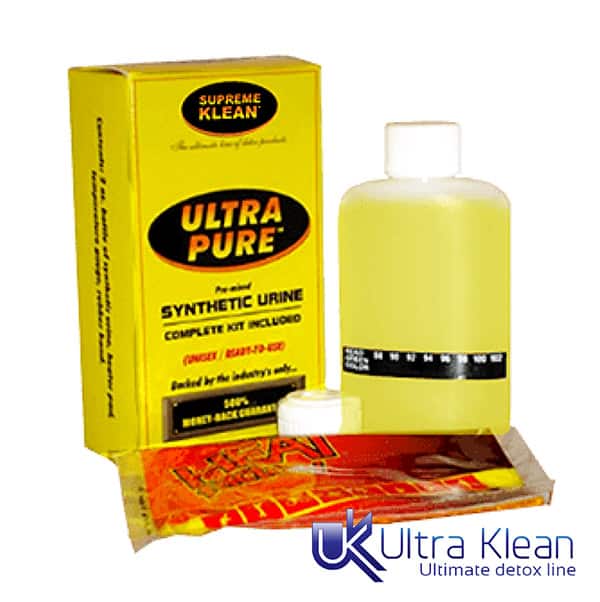
Sellers offer two main forms. Pre-mixed liquid kits work straight from the bottle. Powdered kits need water first. The pre-mixed 4oz Ultra Klean kit is the most popular size for laboratory work. The smaller 2oz kit suits smaller test volumes. The Ultra Klean Complete Kit adds a temperature strip and a heat pack. A realistic sample must sit at body temperature, so those extras matter.
Temperature is not a detail. A sample that is too cold or too hot fails at collection, before any drug testing starts. Kits include a temperature strip. The instructions for using synthetic urine show how to warm a sample to 90–100°F and check the strip before use.
Is Synthetic Urine Legal Under Federal Law?
No federal law makes it a crime to make, sell or own synthetic urine. Congress has not banned the product outright. Federal law does regulate drug testing itself. It sets who can face a test, how collectors handle a specimen, and what counts as a valid result. That is where the risk sits for most people.
Federal workplace and DOT testing
The strictest federal rules cover safety-sensitive transport workers. The U.S. Department of Transportation’s drug-testing procedures in 49 CFR Part 40 set the collection rules. They require a temperature check within four minutes, a minimum volume of 45 mL, a split specimen, and laboratory validity testing. Federal law requires alcohol and controlled-substances testing for commercial drivers.
What happens if a federal test finds a substituted specimen?
A lab can report a specimen as substituted or adulterated. It does so when creatinine and specific gravity fall outside the human range, or when it finds an adulterant. DOT then counts that result as a refusal to test. A refusal carries the same consequences as a positive result. The worker leaves safety-sensitive duties and faces a formal return-to-duty process. Federal law does not need to ban synthetic urine. Its testing rules already punish misuse in a federal test.
State Laws: Where Synthetic Urine Is Restricted
State law is where the answer changes most, because states write these laws in different ways. Most take one of three approaches: banning the sale, banning possession with intent to defraud a test, or banning any adulterant or substitute in a test. Some states use all three, others only one. Sellers can ship a product to one state and not to the next.
Quick Snapshot Comparison
| Feature | Lawful laboratory or research use | Using it to cheat a drug test |
|---|---|---|
| Federal law | Generally allowed — no blanket ban | DOT and federal workplace rules count it as a refusal or failed test |
| Most states | Allowed for lab work, calibration, research and teaching | No criminal ban in many states, but job, school or court consequences still apply |
| States with specific bans | Still allowed for genuine lab and research work, unless a state law says otherwise | Sale, possession with intent to defraud, or use can bring fines and, in some states, jail time |
| Buying online | Legal in most states for a lawful purpose, if the seller ships to your state | Sellers may refuse to ship to states with bans; buying to cheat a test is the use those laws target |
| What a lab sees | A controlled, consistent sample for calibrating equipment | Validity testing can flag a substituted or adulterated specimen |
Which states restrict synthetic urine?
Arkansas, Illinois, Indiana, Maryland, Mississippi, Nebraska, New Hampshire, North Carolina, Oklahoma, Pennsylvania, South Carolina, Texas, Virginia and Wisconsin have laws of this kind, among others. Details differ sharply. One state may ban only the sale, another may ban possession intended to defraud a test, and a third may make using a substitute sample an offence. Penalties range from fines to a misdemeanour charge, and some states allow jail time. The list is not exhaustive, and lawmakers amend these laws regularly, so check your state’s current statute first.
Cannabis law is separate
Do not assume cannabis law settles the question. A state can legalise marijuana and still ban synthetic urine, because the two laws target different things.
Workplace, School, Probation and Court-Ordered Tests
Even in a state with no criminal ban, a test usually follows a contract, a policy or an order. Employers can dismiss a worker who submits a substituted sample, even if no crime took place. Schools can expel a student, licensing bodies can refuse a licence, and courts can treat a substituted probation sample as a violation, with custody consequences. “Not a crime in my state” does not mean “no consequences”.
Read the policy or order first if you face a test. It should say what counts as a valid specimen, what happens after a substituted or adulterated result, and whether you can ask for a retest. In addition, employers and labs should set those rules out in advance, in writing.
How Laboratories Detect Synthetic Urine — and Why It Matters
Modern labs do more than test a sample for drugs. They also run validity tests to check that the sample is human urine. Those tests measure temperature, colour, odour, creatinine, pH and specific gravity. They also look for oxidising adulterants such as nitrites. A sample with almost no creatinine fails those checks. So does one with a pH outside the human range, or a specific gravity that is too low or too high. The lab then reports it as diluted, substituted or adulterated. Cheap formulas fail more often, because some omit uric acid or creatinine altogether.
Quality matters for lawful users too. A calibration sample must behave like real urine. If it does not, it cannot calibrate an analyser correctly. It also cannot train a collector to spot a bad sample. For example, our synthetic urine buyers guide explains what to look for in a formula, including uric acid, creatinine, pH and specific gravity. Our guide to whether synthetic urine works explains what labs check and why temperature so often decides the result.
ℹ️ Fast Fact: Under U.S. Department of Transportation rules, a urine specimen must measure 90°F to 100°F (32°C to 38°C) at collection. A lab reports a specimen as substituted when creatinine falls below 2 mg/dL and specific gravity sits at or below 1.0010 or at or above 1.0200. Temperature and validity checks come first, not last.
Lawful Uses of Synthetic Urine
Ultra Klean products are intended for lawful use only — laboratory testing, equipment calibration, research, academic instruction and demonstration — and are not intended for unlawful use, including cheating a drug test.
Labs use synthetic urine as a known, repeatable sample to test new kits, check quality control and train staff, without the biohazard and consent issues of a real sample. It also calibrates analysers against a known result. Researchers study how labs handle, store and test specimens, while teachers use it to demonstrate urinalysis and chain of custody. In each case, consistency is the point: the same ingredients, pH and specific gravity, every time.
Buying Synthetic Urine Legally and Safely
If your purpose is lawful and your state allows the sale, buy from a reputable seller. Check the ingredients and the expiry date. A formula should list urea, creatinine and uric acid, and the kit should include a temperature strip. Store an unopened kit cool and dry. Our guide to how long synthetic urine lasts covers shelf life, and our synthetic urine facts page covers what a kit contains.
Reported Pros and Cons — Lawful Laboratory Use
| ✅ Reported Pros | ❌ Reported Cons |
|---|---|
| Consistent, repeatable composition | Illegal to sell or use to cheat a test in states with bans |
| Ready to use; the Complete Kit adds a strip and heat pack | Must stay at 90–100°F for a realistic test |
| No biohazard risk, unlike a real human sample | Unopened shelf life is typically 2–3 years |
| Available in 2oz and 4oz sizes | Cheap formulas without uric acid or creatinine can fail validity checks |
Before You Buy, Sell or Use It: A Short Checklist
- Check your state law first, and again if you move or ship to another state.
- State your lawful purpose — lab testing, calibration, research, teaching or demonstration — and keep a record.
- Buy from a reputable seller and keep your receipt.
- Store the kit cool and dry, check the date, and check the temperature strip.
- Never use synthetic urine to defraud a drug test.
Frequently Asked Questions
Is synthetic urine legal in the US?
No federal law bans it, and most states allow lawful uses. But more than a dozen states restrict its sale, possession or use to defraud a drug test.
Is it illegal to buy synthetic urine online?
It depends on your state and purpose. Lawful buying is legal in most states, but sellers will not ship to states where the sale is banned.
Can you go to jail for using synthetic urine to pass a drug test?
In states with a ban, yes. It can bring a misdemeanour charge, fines and, in some states, jail time.
Do labs test for synthetic urine?
Yes. Labs test temperature, creatinine, pH, specific gravity and oxidising adulterants. The National Institute on Drug Abuse notes that urine drug screening is the most common form of drug testing.
What is synthetic urine used for legally?
Laboratory testing, equipment calibration, research, academic instruction and demonstration.
The Bottom Line
The law does not treat synthetic urine as one thing. In the lab it is a lawful, useful tool. In a drug test it is a substitute sample that federal rules and a growing number of state laws treat seriously. Check your state law, keep your purpose lawful, and use a kit only for lab testing, calibration, research, teaching or demonstration.